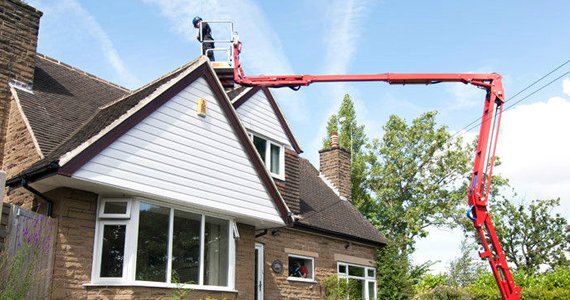
Tell us about your property — Victorian terrace or villa near the station, Edwardian semi in Lucastes or Muster Green, 1920s/30s inter-war house, 1960s–70s estate property, or newer build in Bolnore Village or Heathwood Park. We give you an exact price from £195 immediately over the phone. No online forms, no waiting.
Our specialist assesses every element with Haywards Heath’s specific conditions in mind — Welsh slate or clay tile pitch condition on Victorian properties, flint-and-brick chimney mortar erosion on the Weald Clay substrate, tile-hung panel integrity, lead valley condition on Edwardian rooflines, felt underlay on 1960s–80s concrete tile roofs, flat sections on rear extensions, and gutter continuity throughout.
Full written report with photographs, condition ratings, remaining lifespan estimates, and a prioritised maintenance plan with budget figures. For conservation area properties in Muster Green and Franklands Village: traditional material specifications. For buyers: costed repair schedules to support negotiation on RH16 properties from £400K to £2M+.
Haywards Heath is, in the most literal sense, a railway town. Until the London and Brighton Railway arrived on 12 July 1841 — and even that almost didn’t happen; the line was originally planned to bypass the settlement entirely, and it was local lobbying that secured the station — Haywards Heath was a hamlet of around 200 people. The Sergison family, who owned the "Waste" land around the proposed station, sold it for development after the station was built. Victorian and Edwardian terraces, villas, and detached houses followed the railway tracks almost immediately, and the town that emerged now sits 36 miles south of London, 14 miles north of Brighton, and 15 minutes from Gatwick Airport. London Victoria is 42 minutes by train; London Bridge 44 minutes. The station remains the engine of the town’s economy and its property market.
That Victorian and Edwardian railway-era building boom is the defining feature of Haywards Heath’s property stock — and its roofing challenges. The houses built in the 1850s through to the 1910s to serve the growing commuter population are now 115–175 years old. Welsh slate pitches, original lead valley liners, flint-and-brick chimney stacks, tile-hung upper storeys in the Sussex vernacular tradition, and Victorian rear kitchen additions with early flat-roofed sections: all are at or approaching the point where a specialist roof assessment from £195 delivers the clearest picture of what needs attention and what can wait. Add to this the Weald Clay ground conditions that produce seasonal shrink-swell movement, and a set of roofing challenges specific to this Mid Sussex town emerges clearly.
Victorian and Edwardian pitched roofs: The Welsh slate roofs of the station-area terraces (now 130–160 years old) and the clay plain tile roofs of the Edwardian villas in Lucastes and around Muster Green are the dominant roof type in central Haywards Heath. Slates become porous and delaminate; nibs corrode on iron-fixed clay tiles; original lead valleys fatigue and crack at stress points. Standard homebuyer surveys assess these from the ground. A specialist survey gets close enough to distinguish weathered but sound from actually failing.
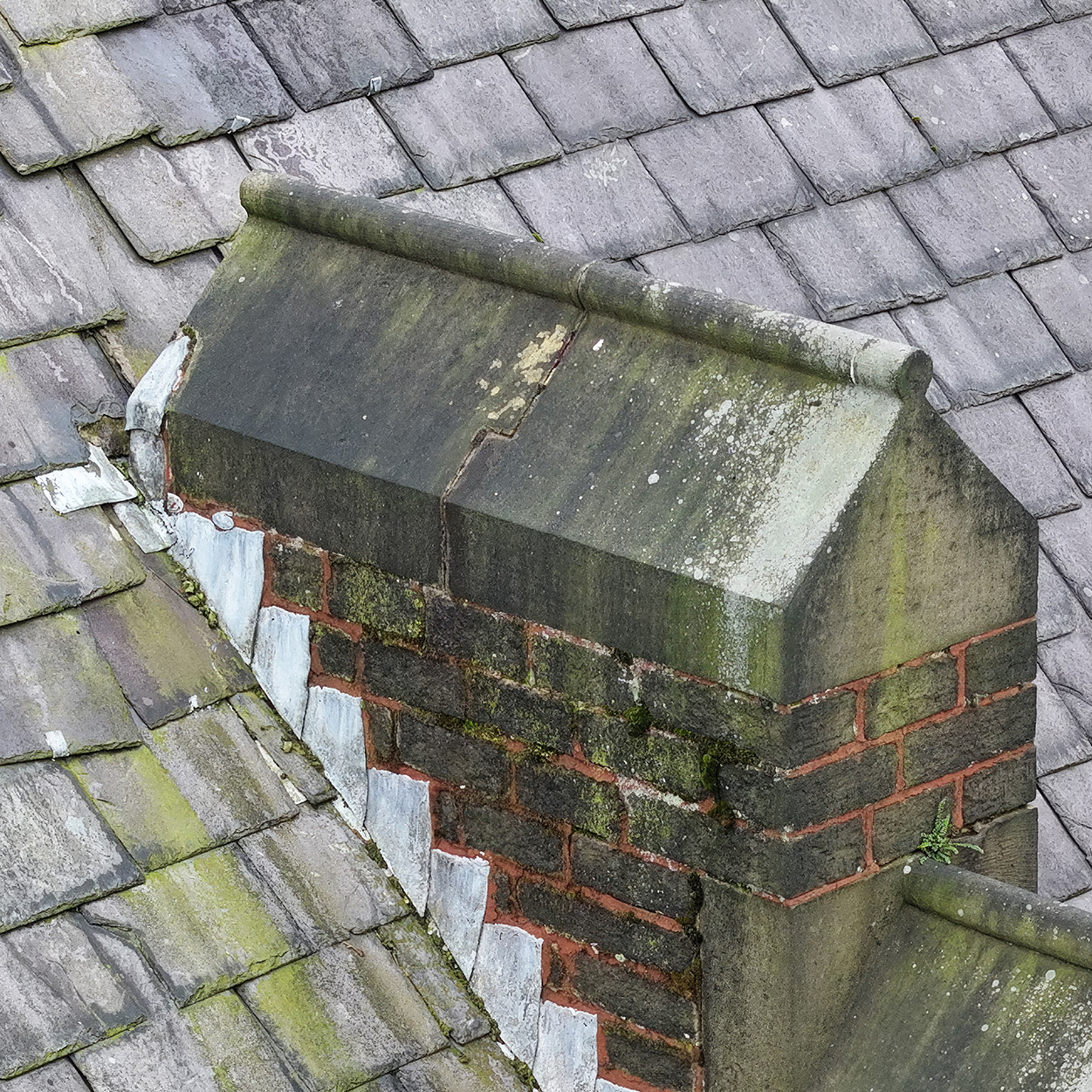
Flint-and-brick chimney stacks: The quintessential Sussex vernacular material — flint cobbles set in lime mortar, with brick quoins and capping — is common throughout Haywards Heath’s Victorian and Edwardian stock. Flint itself is impermeable, but the lime mortar joints erode over decades. When pointing erodes to 10–15mm depth, capillary action draws rainwater into the stack; on the Weald Clay substrate, seasonal ground movement opens existing hairline cracks further each winter. The result is moisture entering the roof void through the chimney structure rather than through any failure of the tile or slate covering — a source that standard surveys rarely locate accurately.
Tile-hung upper storeys: Many Haywards Heath Edwardian and inter-war properties feature tile-hung upper storeys — clay plain tiles hung on battens to provide weather protection for the upper walls. These panels age at different rates depending on aspect: north and north-east facing panels in the shade of mature Mid Sussex garden trees may be failing significantly faster than south-facing panels on the same property. A survey that assesses only the roof covering misses tile-hung panel failure, which can allow moisture into the upper wall structure at first-floor ceiling level.
Weald Clay movement and extension junctions: Haywards Heath sits on Weald Clay — a shrink-swell substrate that contracts in dry summers and expands in wet winters. Victorian properties have experienced 150+ cycles of this movement. The highest-risk points are chimney stacks (subject to differential movement between the stack and the main roof structure), and the junctions between original Victorian roof sections and later extensions where different parts of the property may sit on different ground conditions. These junctions — often a lead flashing or cement fillet between the original roof and a 1950s–80s rear extension — are among the most common sources of undetected moisture ingress.
Nearby Areas: We also cover Burgess Hill, Horsham, Crawley, East Grinstead, and Lewes.
Haywards Heath’s Victorian and Edwardian railway-era properties — Welsh slate pitched roofs, flint-and-brick chimney stacks, tile-hung upper storeys, original lead valley liners — are now 115–175 years old and require specialist assessment that understands the specific combination of Sussex vernacular materials, Weald Clay ground movement, and Mid Sussex weather patterns. We have direct experience of every era in the Haywards Heath property market, from the 1840s station-area terraces to the Bolnore Village new builds of the 2000s.
A family purchased a four-bedroom Edwardian detached villa in the Lucastes area of Haywards Heath for £785,000. The property dated from approximately 1906 — bay-fronted, tile-hung upper storey in clay plain tiles, Welsh slate pitched main roof, two flint-and-brick chimney stacks, and a rear single-storey kitchen extension added in the 1970s with a felt flat roof. The homebuyer’s survey described the main roof as “age-appropriate condition; slates visible from ground level appear sound.” It noted both chimney stacks as requiring “routine repointing,” recommended a specialist inspection of the flat roof addition, and assessed the tile-hung upper storey as “serviceable.” No specialist inspection was commissioned for either the flat roof or the chimneys beyond the homebuyer survey. The family completed and moved in.
Six months later, first significant autumn rain: A damp patch appears on the bedroom ceiling on the north-west side of the property — not below the flat roof section, but below the main slate pitch, adjacent to the larger of the two chimney stacks. A local roofer investigates, checks the slates around the chimney from a ladder, finds no broken slates, repoints the visible flashing cement with fresh mortar. The damp patch dries out.
The following spring: The damp patch returns in the same location, now slightly larger, with a faint staining pattern tracking diagonally down the plaster from the ceiling to mid-wall. A second roofer climbs higher and examines the chimney stack itself. He identifies that the flaunching — the sloped cement mortar around the base of the chimney pots — is cracked in two places and recommends replacement. Flaunching replaced: £380. The damp patch dries out again in summer.
Second autumn: The damp patch returns, now visibly worse and accompanied by a musty smell. An investigation using a borescope camera (inserted through a small access hole drilled in the bedroom wall) reveals that the north-west chimney stack has been progressively allowing water into the roof void, not through the flaunching (now repaired) but through the flint-and-mortar body of the stack itself: the lime pointing in the flint courses has eroded to an average depth of 18mm on the north-west face — the face that takes the prevailing weather — and for at least three winters, rainwater has been running into the eroded joints and draining into the roof void where the stack penetrates the roof structure. The timber around the stack base — rafters, noggins, and sarking felt — has been wet intermittently for years. Active wet rot is present in two rafter sections adjacent to the stack. Remediation: scaffold the stack, strip flint face and fully repoint in matching lime mortar, replace two rafter sections and treat surrounding timber, strip and relay slate section around base of stack, replace lead flashing. Cost: £9,500–£13,000.
What a Roof Survey Haywards Heath Specialist Would Have Identified at Purchase: “North-west chimney stack: flint-and-lime mortar construction. North and north-west faces show mortar erosion to approximately 18–20mm depth across multiple courses. At this erosion depth, capillary water ingress into the stack body is occurring during sustained rain. This is the primary water ingress risk on this property — not the slate pitch. Recommend full lime repointing of NW face prior to exchange, or price reduction of £8,000–£12,000 to cover post-purchase remediation including scaffold access and rafter inspection. Flaunching: replace as routine. Flat roof addition: felt covering is original 1970s installation, at or beyond design life — renewal recommended within 12 months. Tile-hung NW panel: biological growth present, 15% of tiles showing nib corrosion; proactive maintenance within 2–3 years.”
The Flint Chimney Pattern: Flint-and-lime mortar chimneys in Haywards Heath are assessed from ground level in standard surveys and almost always described as “requiring repointing.” This gives no information about whether the erosion is superficial (5–8mm, cosmetic) or significant (15mm+, active water ingress). A £195 specialist survey close-inspects both chimney stacks and distinguishes between the two.
Haywards Heath roof surveys start from £195. At RH16 property prices of £400K–£900K+ for Victorian and Edwardian stock, a £195 specialist survey that identifies £10,000–£15,000 of hidden remediation work before exchange is the most cost-effective professional fee in any property transaction. We assess Welsh slate and clay tile pitches, flint-and-brick chimney stacks, tile-hung panels, flat roof additions, lead valley condition, and Weald Clay movement effects on all masonry structures.
Call 07833 053 749 for an exact quote immediately over the phone — fixed price, no ambiguity. Detailed written report with photographs within 48 hours. Conservation area material guidance for Muster Green and Franklands Village properties included as standard. Same-day service often available across RH16 and RH17.
For landlords with multiple Haywards Heath properties: portfolio scheduling available with maintenance programmes across RH16, RH17, and surrounding Mid Sussex postcodes.
Standard homebuyer surveys assess Haywards Heath’s Victorian and Edwardian railway-era properties from ground level and routinely miss flint chimney mortar erosion depth, tile-hung panel nib failure, and flat roof addition condition. At RH16 prices of £400K–£900K+, a £195 specialist survey provides the specific, costed detail to negotiate with confidence or budget accurately for year-one work.
The combination of flint chimney stacks, tile-hung panels, ageing flat roof additions, and Weald Clay movement creates multiple simultaneous potential moisture entry points in Haywards Heath period properties. Piecemeal investigation by individual tradesmen rarely resolves these because each looks only at their own area. A whole-system survey identifies root causes rather than symptoms.
Muster Green conservation area, Franklands Village conservation area, and the Grade II listed Priory of Our Lady of Good Counsel on Franklynn Road represent the highest-designation properties in Haywards Heath. Repairs to listed structures must use traditional materials — handmade clay plain tiles, natural slate, lime mortar — and satisfy listed building consent requirements. We identify what is needed and specify conservation-compatible approaches.
Victorian terraces and villas throughout Haywards Heath were extended at the rear — typically by the 1950s to 1980s — with single-storey kitchen additions covered in built-up felt. This felt is now typically 40–70 years old, at or well beyond its designed service life. Standard surveys note it as “specialist inspection recommended” without actually assessing condition. A specialist survey tells you specifically whether renewal is urgent (within 12 months), imminent (1–3 years), or medium-term (3–5 years).
Before any significant structural work, understanding the existing roof’s condition prevents costly mid-project discoveries. Where a loft conversion will involve opening up the roof structure, a pre-works survey identifies existing issues — wet rot in rafter ends, compromised sarking felt, non-standard previous repairs — that must be resolved before the conversion begins. A survey now saves significant cost and disruption later.
The villages immediately surrounding Haywards Heath — Lindfield (with its 16th-century High Street properties), Cuckfield (medieval village with listed buildings), and Ardingly (home to Wakehurst Place) — have some of the oldest and most historically significant building stock in Mid Sussex. These require the same specialist assessment knowledge, plus specific expertise in older construction methods and traditional repair materials. We cover the full RH16, RH17, and RH15 postcode area.
Haywards Heath’s property stock reflects its history as a railway-created town. The London and Brighton Railway arrived in 1841 and the town grew rapidly from a hamlet of 200 to a substantial commuter town. The Victorian and Edwardian houses built during that railway-era boom — now 115–175 years old — present specific roofing challenges: Welsh slate pitches nearing end-of-life, original lead valley linings, flint-and-brick chimney stacks susceptible to mortar erosion on the Weald Clay substrate, and tile-hung upper storeys with clay plain tile panels that age at different rates by aspect. Standard ground-level assessment cannot adequately assess any of these.
Haywards Heath sits on Weald Clay — a shrink-swell clay that expands when wet and contracts in dry conditions. Over 150+ cycles of seasonal movement, chimney stacks develop hairline cracks at mortar joints, parapet walls shift, and the junctions between original Victorian roof structures and later extensions can open up. Assessment of chimney stacks, parapet walls, and all extension roof junctions should specifically check for movement-related cracking that standard surveys miss when they assess from ground level.
Flint cobbles set in lime mortar with brick quoins and capping is the quintessential Sussex vernacular building material, seen throughout Haywards Heath’s Victorian and Edwardian stock. Flint itself is impermeable, but the lime mortar joints erode over decades. When pointing erodes beyond approximately 10–12mm depth, capillary action draws rainwater into the stack body; on the Weald Clay substrate, seasonal ground movement progressively opens existing cracks. The result is moisture entering the roof void through the chimney structure — a source that standard surveys routinely describe only as “requires repointing” without assessing whether the erosion is superficial or active. We measure erosion depth on all flint stacks and report specifically.
All Haywards Heath including Lucastes, Fox Hill, Muster Green, Franklands Village, Bolnore Village, Ashenground, the station area, and Perrymount Road. We also cover Lindfield, Cuckfield, Ardingly, Balcombe, Scaynes Hill, and throughout the RH16, RH17, and RH15 postcode areas. For nearby towns: Burgess Hill (RH15), Horsham (RH12), and East Grinstead (RH19) are all within our regular coverage.
Yes. While Bolnore Village (built from early 2000s) and Heathwood Park in Lindfield (2017 onwards) are significantly newer than Haywards Heath’s Victorian stock, modern timber-frame new builds present their own roofing assessment needs: concrete or clay interlocking tile systems, EPDM or GRP flat roof sections over garages and single-storey extensions, and the early identification of any defects in the first decade of occupation before warranties expire. We survey all property eras across RH16.
Haywards Heath roof surveys start from £195. Call 07833 053 749 for an exact quote over the phone immediately — fixed price based on your property type. Most surveys take 2–3 hours on site. Victorian properties with flint chimney stacks, tile-hung elevations, or flat roof additions may take 3–4 hours for thorough assessment. Written report with photographs within 48 hours.
Haywards Heath sits at the upper-mid range of the Mid Sussex property market — significantly more affordable than nearby villages like Lindfield and Cuckfield, but substantially higher than many East Sussex equivalents at the same commuter distance from London. The Victorian and Edwardian stock around the station and in Lucastes typically sells for £500K–£900K+; inter-war properties for £400K–£650K; and the modern new builds in Bolnore Village and at Heathwood Park in Lindfield from £600K to over £1M. The Victorian convent chapel conversion on Bolnore Road — built 1886, Grade II listed — recently guided at £2M–£2.25M, reflecting the premium that genuinely historic stock commands in this market.
The town has 6 conservation areas and approximately 45 listed buildings within its boundaries. Muster Green — the site of the December 1642 Battle of Muster Green where Parliamentarians defeated a Royalist force under the High Sheriff of Sussex — is among the conservation areas, as is Franklands Village, the 1930s social housing initiative that became a model of its kind. For buyers at any price point, the combination of Victorian-era material complexity, Weald Clay ground movement, and the specific challenges of Sussex vernacular construction (flint chimneys, tile-hung panels) makes a £195 specialist roof survey the most cost-effective professional step available before exchange.
Lucastes, Fox Hill, Muster Green, Franklands Village, Bolnore Village, Ashenground, station area, Perrymount Road — full RH16 coverage. Plus Lindfield (RH16), Cuckfield, Ardingly, Balcombe, Scaynes Hill (RH17).
Burgess Hill • Horsham • Crawley • East Grinstead • Lewes
Whether you are buying a Victorian villa in Lucastes, maintaining an Edwardian semi near Muster Green, managing a 1930s property in Franklands Village, or assessing a period cottage in Lindfield or Cuckfield, a specialist roof survey from £195 gives you the clarity that a standard survey cannot. Flint chimney mortar erosion depth, tile-hung panel nib failure by aspect, flat roof addition condition, Weald Clay movement effects on extension junctions — these are the specific Haywards Heath challenges that matter.
Call 07833 053 749 now for an exact price immediately. Detailed written report and photographs within 48 hours. Same-day service often available across RH16 and RH17.